
Request More Images
You can find images of this object above. Click on an image to zoom.
In case you are looking for additional images, please email us at ritesh@indikeauctions.com or use the request form below.


REGISTERED ANTIQUITY – NON-EXPORTABLE ITEM.
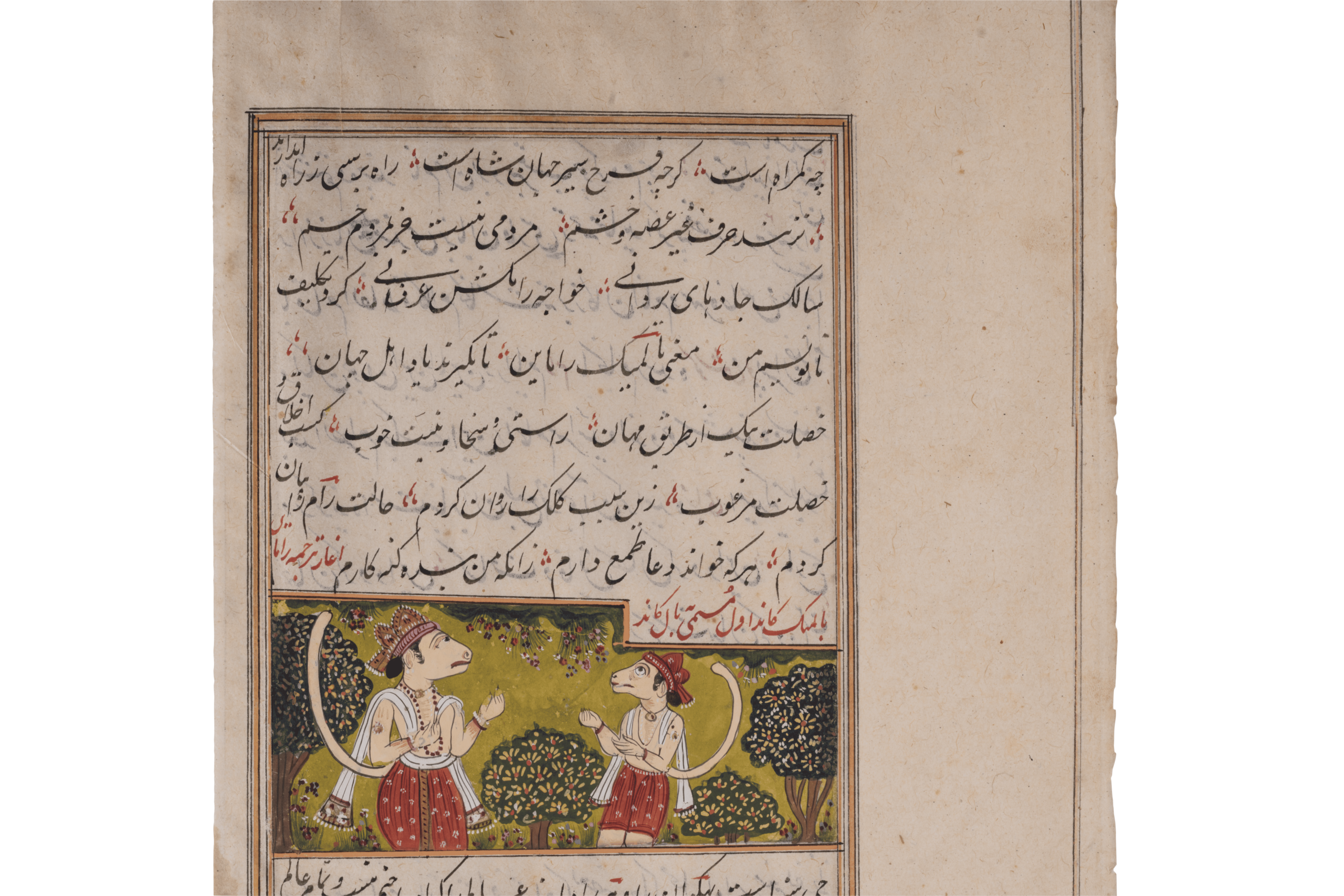
The Ramayana (Adventures of Rama) narrates the epic saga of the valiant Prince Rama and his dutiful wife, Princess Sita, who Ravana abducted, the arrogant ten-headed King of Lanka (probably modern Sri Lanka), during Rama’s unjust fourteen-year forest exile from his capital of Ayodhya (near Faizabad in Uttar Pradesh). To rescue Sita, Rama and his faithful brother Lakshmana assembled a great army of monkeys and bears led by the Monkey-King Sugriva and his Monkey-General Hanuman. After several magical battles, the princess was freed, and the happy couple triumphantly returned home to rule Ayodhya.
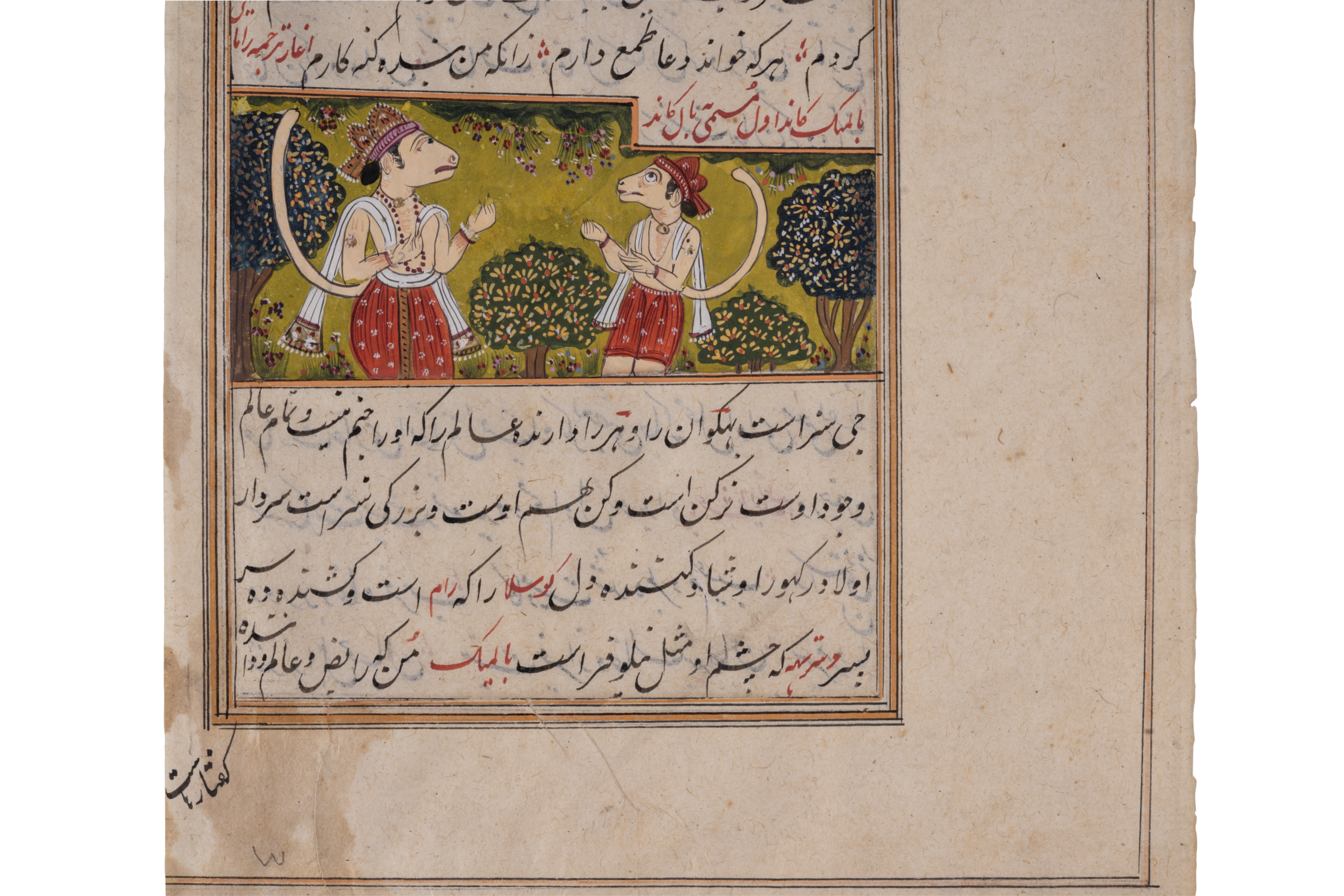
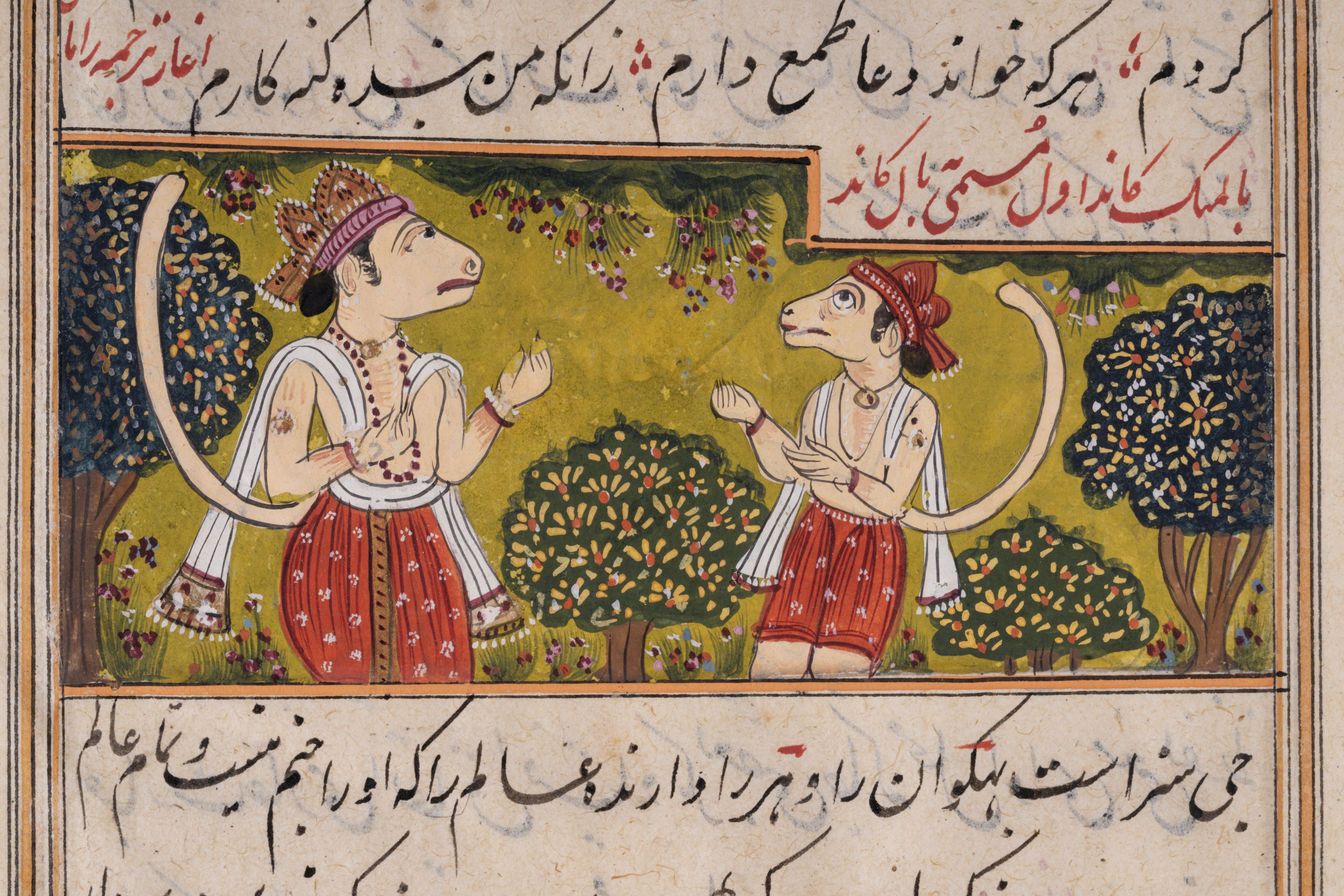
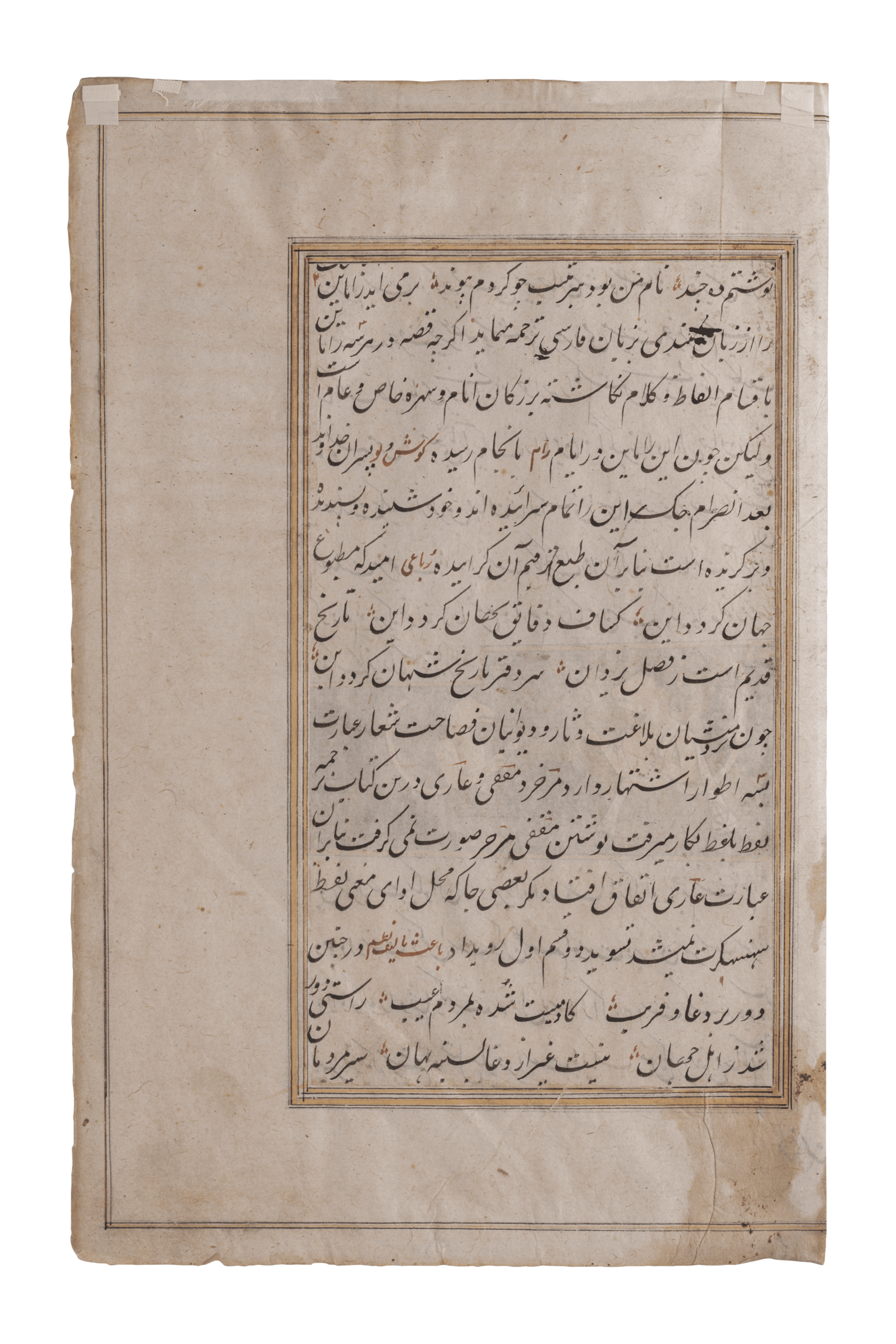
This carefully illustrated manuscript leaf showcases the late Mughal miniature style, produced in the late 18th century (1780-90) in Lahore (in present-day Pakistan). It is made in ink and gouache on paper, illustrated with a delicate double border and Persian text written in ornate nasta‘liq script that blends Persian refinement with Indian mythological themes. It likely comes from one of several Persian translations of the Ramayana, such as the Razmnāma, which follows a standard Persian tradition that maintains a balance between text and image, juxtaposing vivid colours, stylised foliage, and elaborate costumes found in Rajput and Deccani miniatures. The elongated eyes and rhythmic outlines of the figures evoke an Indian sensibility while reflecting a Persian compositional order.
The scene in the centre of the frame depicts two Vanaras, likely Hanuman and Sugriva, talking in a lush grove that dramatises Kishkindha, the mythological forest kingdom of loyalty and divine duty. The animated gestures and Mughal-inspired attire evoke the way Hindu narratives were adapted for a Persianate audience. This folio encapsulates the syncretic spirit of Indo-Persian art, where Hindu and Muslim artists came together to harmonise sacred epic storytelling with a refined visual tradition of manuscript art that expressed early modern India’s pluralistic and devotional visual culture.
The script in this painting is Persian (written in nasta’liq calligraphy), and the painting is a Mughal miniature dating to circa. late 18th century (1780-90). The description in this set is episodes from the Ramayana. In the folios in ‘red’ font, reads ‘Agaz Tarjuma Ramayan’, Baal Kand Aval Masumi, which means ‘Beginning translation of Ramayana’, Baal Kand, first season ( translation of the script provided at the end ).
The first Valmiki-Ramayana in Persian was one of the most celebrated manuscript projects of translation and illustration of any Hindu Sanskrit text, after Razmnama (The Book of Wars, the Persian translation of the Mahabharata), commissioned by Emperor Akbar (r.1556-1605), during his later regnal phase from 1580 to 1590 CE. This came after the illustrations of several series of Persian historical texts, tales and memoirs, including the enormous Hamzanama, the Tutinama and the Akbarnama.
The Ramayana of Akbar marked the development of a new stylistic genre in the Mughal courtly art under Akbar’s patronage. The splendid illustrations of Akbar’s Ramayana are highly renowned for their acute naturalism, refined execution and the brilliance of surface treatment. A vivid and sophisticated colour palette and distinctive style defining the dynamic conflation of Indo-Persian aesthetic quality values represent the epitome of the classical Mughal idiom that developed during the Akbar period. A proclivity for the Persian classicism and Timurid aesthetic came by inheritance, but the Indianised nature and character were foundational for the Mughal school of paintings.
This illustrated manuscript is a classic example of the assimilation of the indigenous culture and religious sentiments in the Mughal court and the excellent workmanship of the artists of the royal atelier. The paintings reflect the extraordinary creative skills of the artists and their technical proficiency in deftly illustrating the narrative of Hindu origin in a different religious milieu by creating a coherent link between the text and the image. They represent visual interpretations of the varied emotive content, temporal spaces and moral dimensions of Rama’s mythology, exuding a variety of metaphorical elements with symbolic values.
From a Private Collection in Mumbai, India.
Good Condition.
Text panel 24.5cm x 13.5cm, Folio 34.5cm x 22cm.
1. Hanuman Visits Sita in Lanka and Other Exploits, Folio from a Ramayana (Adventures of Rama)India, Gujarat, circa 1775-1800, Drawings; watercolors, Opaque watercolor and ink on paper 6 1/2 x 12 1/2 in. (16.51 x 31.75 cm). Purchased with funds provided by Christian Humann (M.72.11) https://collections.lacma.org/node/238305
2.The Visualisation of Ramayana in the Mughal Paintings under Akbar’s Patronage, By Abira Bhattacharya, 2019, Sahapedia. https://www.sahapedia.org/visualisation-ramayana-mughal-paintings-under-akbars-patronage#:~:text=Introduction,developed%20during%20the%20Akbar%20period
3. Mughal Miniature Painting: An Analytical Study of the Akbar’s Ramayana, October 2023, Kupas Seni 11(2):53-66, Ramin Hajianfard, City University Malaysia. https://www.researchgate.net/publication/374467105_Mughal_Miniature_Painting_An_Analytical_Study_of_the_Akbar’s_Ramayana
4. ILLUSTRATED RAMAYANA MANUSCRIPTS (Published in Vihangama 2003 Vol. I (January – February), By Dr. Virendra Bangroo, https://ignca.gov.in/PDF_data/Illustrated_Ramayana_Manuscripts.pdf
You can find images of this object above. Click on an image to zoom.
In case you are looking for additional images, please email us at ritesh@indikeauctions.com or use the request form below.
Buying at Indike is simple. Our friendly team of experts are always willing to discuss items entered in the auctions and also those that are currently available in our online shop with potential purchaser. All members of our dedicated team are here to help should you need any assistance. Please note that all items purchased are subject to our standard terms and conditions.

Bid live on our website, without additional online surcharges!

Bids are open until the window closes. Highest bid wins.
By accessing or using this website, mobile application, or any services provided by Indike, you acknowledge and agree to comply with the following terms and conditions. These terms govern your use of our platform and all content, features, and functionality made available through it. Use of this site is conditioned upon your acceptance of and compliance with these terms. If you do not agree with any part of the terms, you must not use the website or services.
All content provided on this site, including but not limited to text, graphics, logos, images, and software, is the property of Indike or its licensors and is protected by intellectual property laws. Unauthorized use, reproduction, or distribution of any content is strictly prohibited.
The information provided on this website is for general informational purposes only and may be subject to change at any time without notice. We do not warrant the accuracy, completeness, or reliability of any content on the site. Any reliance you place on such information is strictly at your own risk.
We reserve the right to suspend or terminate your access to the website without notice, for conduct that we believe violates these terms or is harmful to other users, us, or third parties, or for any other reason at our sole discretion.
You may not use this website in any way that causes, or may cause, damage to the website or impairment of its availability or accessibility. You may not use it for any unlawful, illegal, fraudulent, or harmful purpose or activity.

REGISTERED ANTIQUITY - NON-EXPORTABLE ITEM. Object Detail The Ramayana (Adventures of Rama) narrates the epic saga of the valiant Prince Rama and his dutiful wife, Princess Sita, who Ravana abducted, the arrogant ten-headed King of Lanka (probably modern ...read more

REGISTERED ANTIQUITY - NON-EXPORTABLE ITEM. Object Details This silverware was likely produced in early 19th-century Calcutta. The Lion finial on top attracts the viewer’s eye. The lion appears victorious, alert, and progressing. Lion is a symbol of power ...read more

REGISTERED ANTIQUITY - NON-EXPORTABLE ITEM. Object Detail This silver ewer was made in Burma (present day – Myanmar)— most likely in Mandalay or Rangoon — between 1880 and 1900 CE. It has an influence of the Konbaung dynasty. ...read more

REGISTERED ANTIQUITY - NON-EXPORTABLE ITEM. Object Detail This early 18th-century Deccani miniature from the Hyderabad school portrays a royal figure seated on a bright yellow stool or gilded cushion, examining jewels offered by a tradesman. Before him kneels ...read more
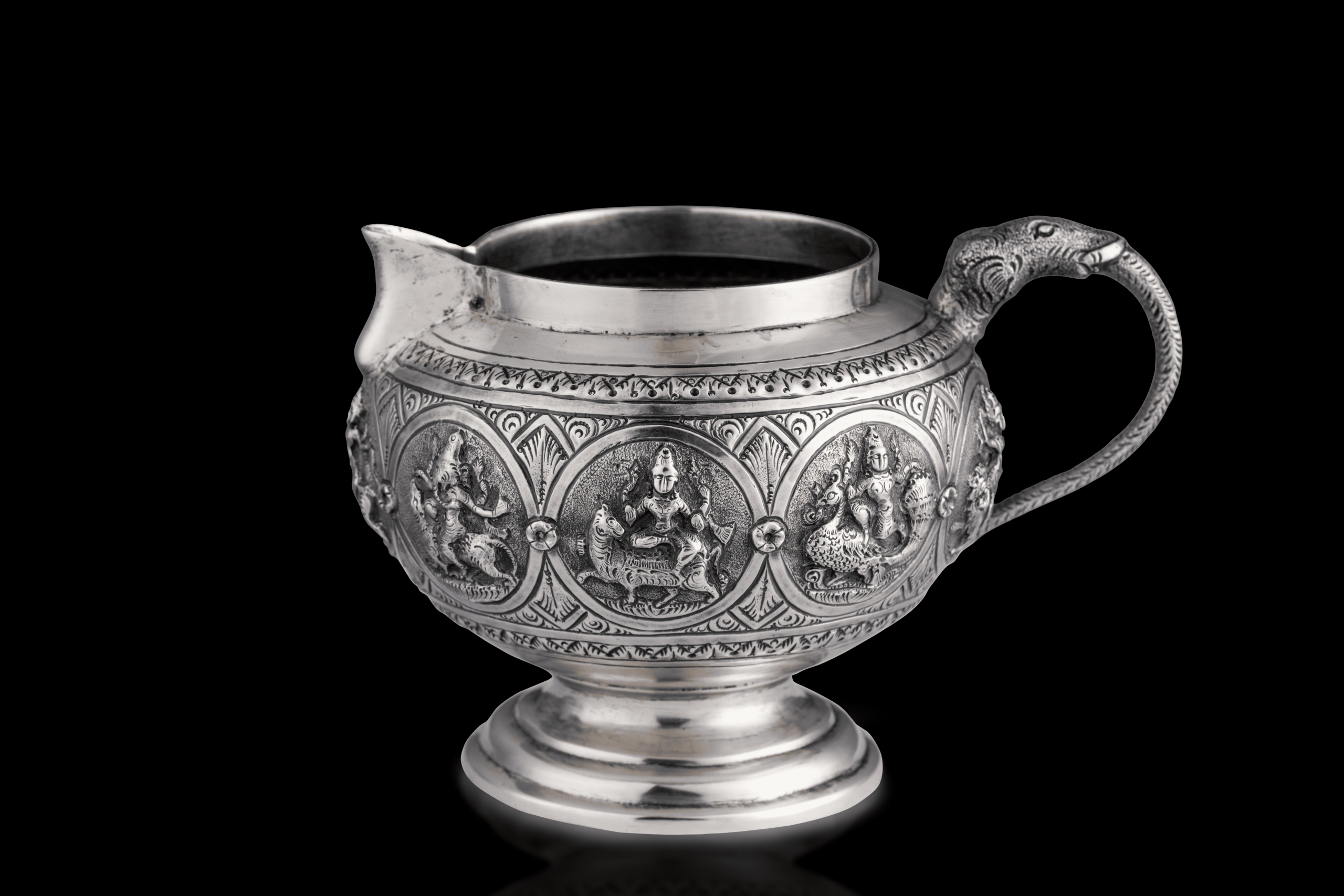
REGISTERED ANTIQUITY - NON-EXPORTABLE ITEM. Object Detail Provenance From a Private Collection in Mumbai, India. Condition Good Condition with minor wear. Dimension Literature Comparison. ...read more

REGISTERED ANTIQUITY - NON-EXPORTABLE ITEM. Object Detail Papier mache, derived from the French term "papier mâché," translates literally to "chewed or mashed paper." Kashmir is recognised as the primary centre for this craft, which has Persian origins. In ...read more
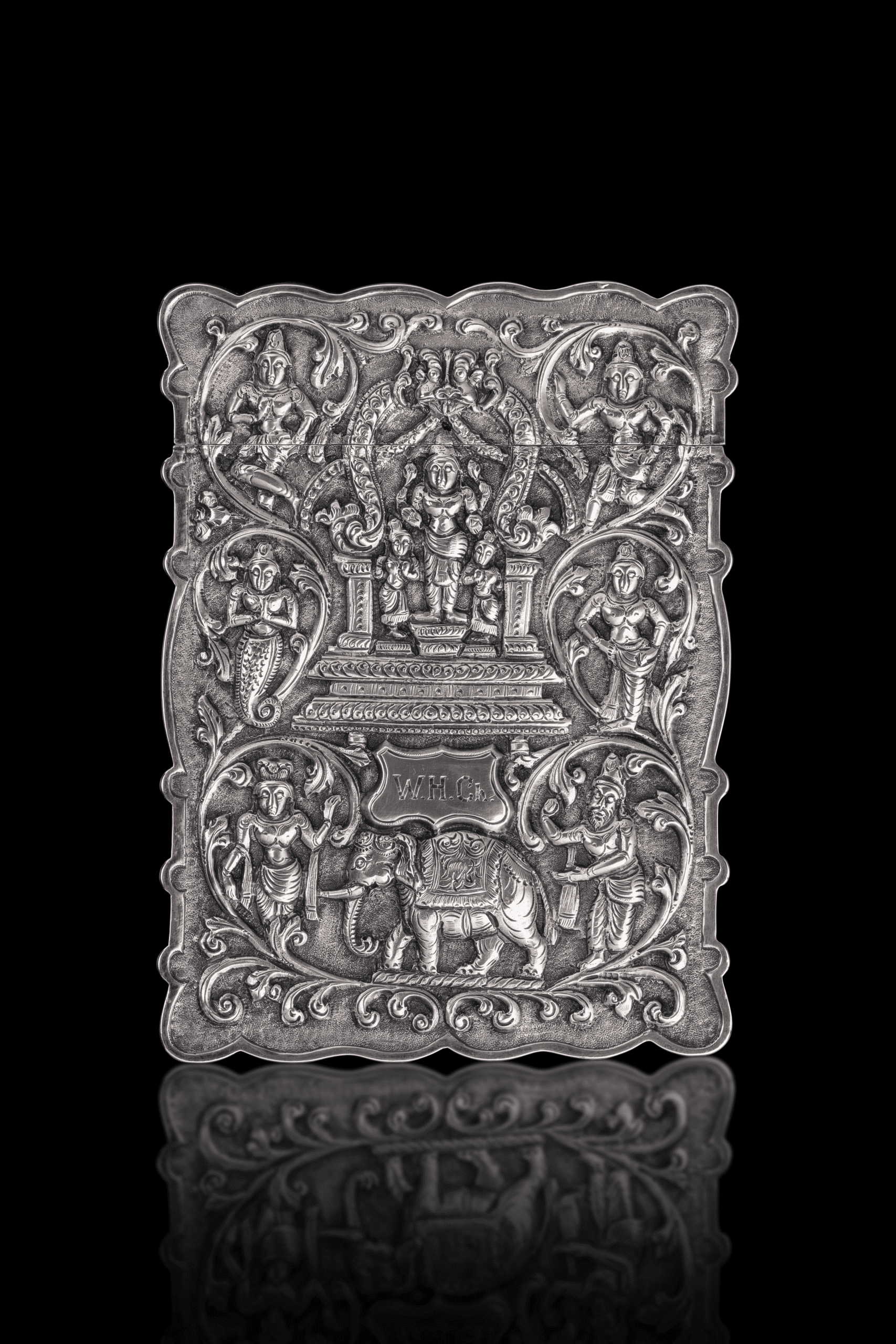
REGISTERED ANTIQUITY - NON-EXPORTABLE ITEM. Object Detail This Silver case, probably a card holder features a beautifully scalloped edge, enhancing its aesthetic appeal. At the centre, Lord Viṣṇu is depicted in a sampada (standing with the ...read more
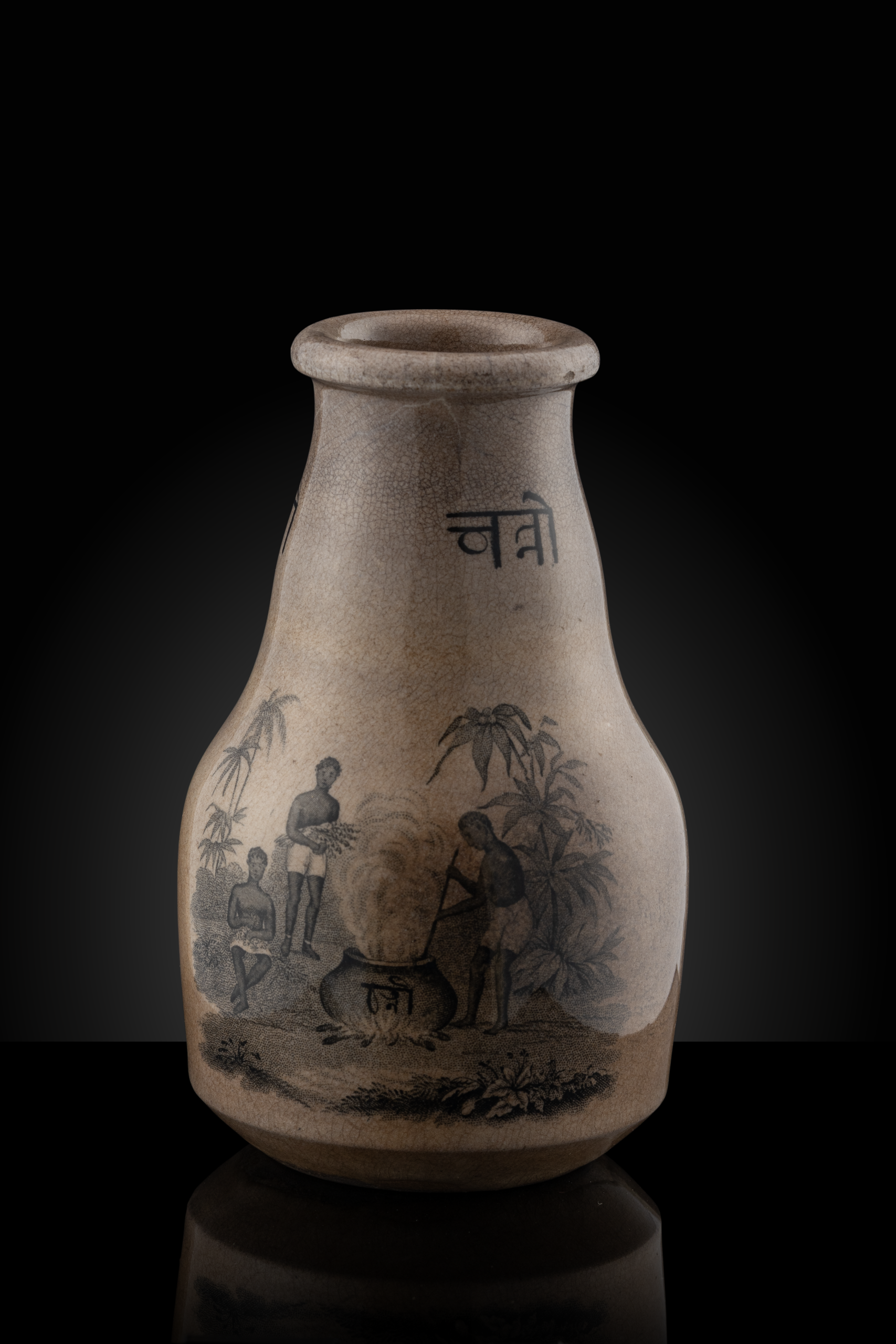
REGISTERED ANTIQUITY - NON-EXPORTABLE ITEM. Object Detail This vessel, more precisely ‘chutney’ pot as inscribed, is crafted from salt-glazed stoneware, a pottery technique known for its durable, non-porous body and distinctive glassy finish created by introducing salt into ...read more


